Many people are sure that chess is boring and not entertaining, but in fact it is not. After 3 moves in a chess game, each side has more than 9 million different positions, each of which can dramatically change the course of the game. In 1950, US mathematician Claude Shannon calculated the number of non-repeating chess games by deriving the Shannon number – 10 to the 120th power. Theoretically, the longest game in chess can be a game consisting of 5,949 moves. But these are not all interesting facts about chess, let’s look at the most interesting ones.
(Not) a boring game: facts about chess
1. Despite the huge number of moves in a chess game, there were some that ended very quickly. The shortest game in the history of chess was played between Ernst Falbe and Leopold Legal in 1860. It ended in just two moves. It is called “Legal’s Pat” and can end in one of two ways.
2. A chess board that could be folded was invented in 1125. The church forbade chess, and to hide his passion, a priest created a board that could easily be confused with books. 
3. In 1997, the Deep Blue computer was the first in history to beat the world chess champion Garry Kasparov.
4. The oldest known chess board was discovered in Scotland and dates back to the 12th century AD. Interestingly, this ancient board’s pieces served as the inspiration for the wizard’s chess pieces in the movie “Harry Potter and the Philosopher’s Stone.” The film’s designers directly modeled their chess pieces after those from this historic set!
5. The word ‘chess’ comes from the Persian words ‘shah’ (king) and ‘mat’ (dead), meaning ‘the king is dead’ or ‘the king is defeated.’ This etymology is preserved in many languages, such as Russian шахматы (shakhmaty) and German Schach, while the term “checkmate” comes directly from the Persian “shah mat.” This reflects the game’s Persian origins, which spread across cultures and languages while maintaining its core linguistic roots.
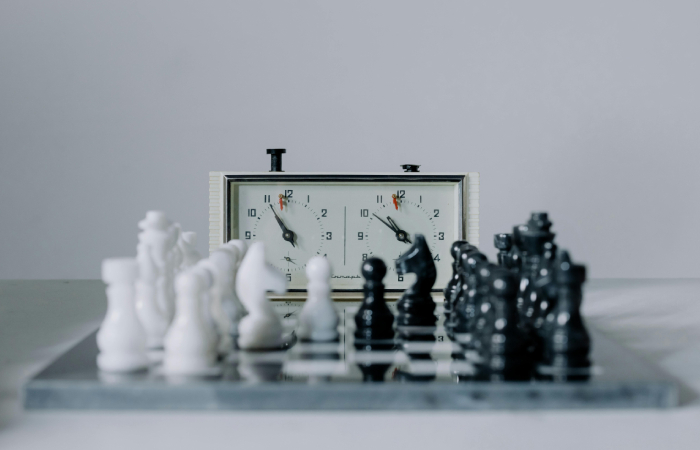
6. Originally there was no clock in chess, causing games to drag on for many hours. In 1851, there was a case when the arbiter recorded that the game was incomplete because the opponents had simply fallen asleep.
7. The world’s first computer program for playing chess was created by Alan Turing in 1951. Due to the fact that at that time there was no machine that could process the program, the scientist had to make algorithmic calculations for a test game, which allowed him to make one move in a few minutes!
8. “Castling” is the only variant in which two pieces move at the same time: the king and the rook.
9. The official chess notation language is called “chess algebraic notation” (Algebraic Notation). It is a standardized method of recording and reproducing chess games, which is widely used in the global chess community. This method allows for accurate and easy recording of each move on the chessboard and is done using letters and numbers to indicate specific moves of the pieces.
10. The youngest world chess champion was the Ukrainian Ruslan Ponomarev at the age of 18. Currently, Hou Yifan is considered to be the youngest chess player in history (14 years 6 months) to become a grandmaster.
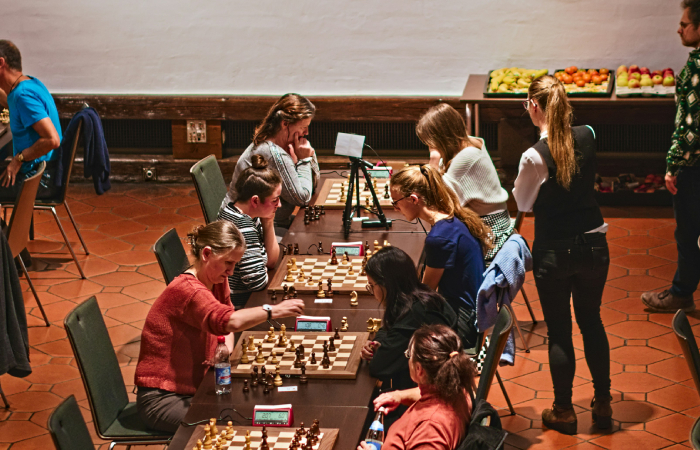
11. In 1973, police raided a chess tournament in Cleveland, arrested the tournament director and confiscated chess sets on charges of allowing gambling (cash prizes to winners). Today, it’s official: the prize money for the World Chess Championship is 2 million euros. The winner of the World Chess Championship gets 60% of the declared sum, and the loser 40%. Vera Menchik’s prize money at the championship in 1927 was only 20 pounds.
12. Chess is considered a sport, and Olympic medals have even been established for chess players.
13. During World War II, some of the best chess players were also code breakers. British masters Harry Golombek, Stuart Milner-Barry and H. O’D. Alexander were part of the team that broke the Nazi Enigma code.
14. Dr. Emanuel Lasker from Germany held the title of the world chess champion longer than any other chess player: 26 years and 337 days.
15. The first mechanical chess clock was invented by Thomas Wilson in 1883. Before that, hourglasses were used. The hourglass was first used in London in 1862. The modern push button clock was first perfected by Veenhoff in 1900.
16. In 1985, Eric Knoppert played 500 games of 10-minute chess in 68 hours.
17. In chess, beginners are often called the rook, the same as the chess piece. This piece is usually one of the last to be moved, and the same can be said about beginners.
18. The second book ever printed in the English language was devoted to chess!
19. In many languages a pawn is an infantryman, but in German and Spanish it is a peasant or farmer.
20. The reason why traditional chess pieces don’t look like real soldiers, elephants, and kings is because before the game came to Europe, it passed through the Islamic world. Islam forbids making statues of animals or people, so the chess pieces began to look fuzzy. When the game spread to Christian Europe, the pieces remained virtually unchanged.
We hope this has deepened your understanding of chess and inspired you to spend more time at the chessboard.