If you are a novice chess player, don’t rush to study the games of the greatest chess players and endgames. Although honing your skills from the games of other players will help you win many victories in the future, learning to play chess is better to start with the basics. Arrangement of chess pieces on the board is the first important element on the road to mastery. How to correctly position the pieces, what are the basic rules and designations – let’s consider it in detail in this article.
Chessboard: preparing the field for the battle
A chessboard is shaped like a regular 8 by 8 square, and each side consists of 8 squares (fields), so it may seem like it doesn’t matter at all how it is arranged. However, there are a few rules that will help the game:
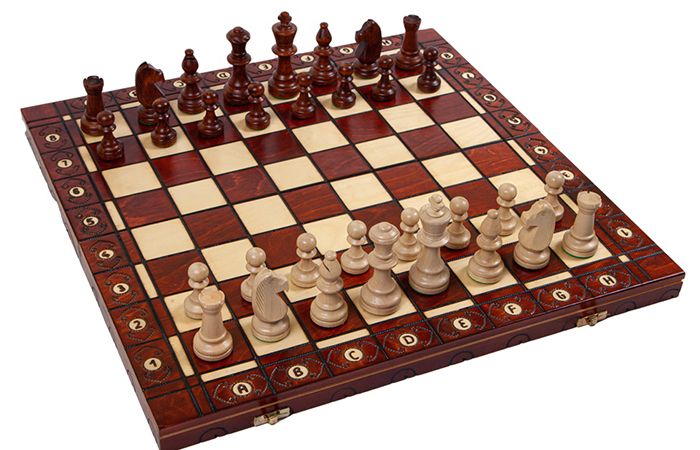
- the board is set up so that the rightmost square for each player is a white square;
- each square has its own personal address. From left to right squares have letter designations from “a” to “h”, and from top to bottom – numbers from 1 to 8. The correct position is when the white pieces are on the 1st and 2nd ranks, and the black pieces are on the 7th and 8th ranks. This will help in recording moves (notation): a8, c5, g4. Using the generally accepted rules, players will easily be able to analyze the game.
Chess piece designations
In order to “read” games, moves, it is necessary to competently record the course of the battle, and to use the generally accepted designation of pieces: 
- King- K;
- Queen – Q;
- Bishop – B;
- Rook – R;
- kNight – N;
- pawn – (p). Pawns may not be marked.
In addition to letters, symbols are used for chess pieces. Additional symbols such as “+”, “#” or “x” can be added to indicate check, checkmate or capture of a piece. They are needed to depict the position of units on the board in manuals, books. The rules for designating pieces are called chess notation, which every player needs to learn.
The position of the pieces on a chessboard
At the beginning of the game there is a certain position for each unit. In each set there are 2 rooks, knights, bishops. These pieces occupy a white and a black square diagonally. Of course, in the process of the game they will move, but the initial arrangement of the pieces in chess is unchanged.

How to position pawns on the chessboard?
Let’s start with pawns. They occupy the entire second row horizontally, so no difficulty will arise, and it would be easier to fill the remaining space. Pawns create the first defensive line, so the move of the pawn is only forward.
Where to place the rook on a chessboard?
Rooks are placed at the corners. To simplify remembering, imagine the rooks as towers of a fortress.
Where to place the knight on a chessboard?
Once you have memorized where the rook is, the Knight piece will no longer be a problem, since it is next to the tower. Always.
Where to put the bishop on a chessboard?
There is a bishop standing next to the knight. When the arrangement of pieces on the chessboard is complete, the bishops will stand between the knight and the queen.
Where to put the queen?
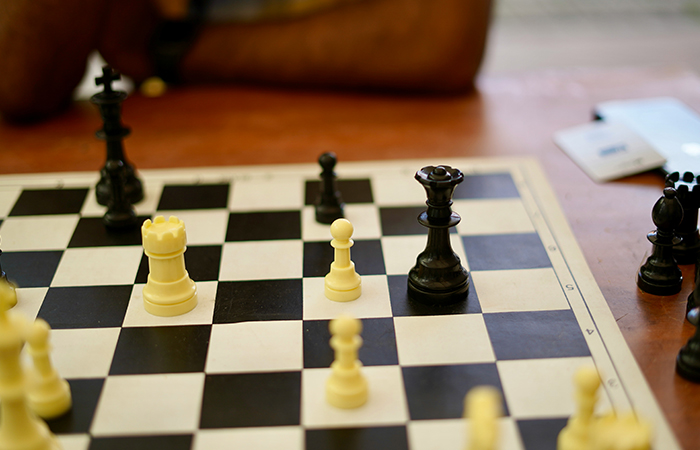
Beginners often confuse exactly where to place the queen. Placing the queen in the center of the back row gives them a wide reach of the board. This piece can move in any direction vertically, horizontally and diagonally. Very important: the color of the queen coincides with the color of the field where it is located. A white queen occupies a white field, a black queen occupies a black field.
Where to put the king on a chessboard?
After positioning the pieces on the board there is only one free place left – the king, so even beginner chess players can easily cope with this stage.
Recommendations for beginner chess players
The rules of piece positioning are the first step for every beginning chess player. When players have completed the arrangement of their side, it is necessary to compare it with the opponent’s side. They must be symmetrical.
| Positions of black pieces | Positions of white pieces |
|---|---|
| rook on a8 and h8 | rook on a1 and h1 |
| knight on b8 and g8 | knight on b1 and g1 |
| bishop on c8 and f8 | bishop on c1 and f1 |
| queen on d8 | queen on d1 |
| king on e8 | king on e1 |
If it is not so, then someone made a mistake. Correct the inaccuracies and start the game: white always go first. The first move can be made by any pawn or knight. Only the knight can move (conventionally speaking) through pieces. The other pieces walk only on free squares of the field and observe the color of the field for a piece. Namely the bishop walks strictly on the squares of its color.
In chess there is a rule of “touching a piece”: if you have taken a piece, move. If a player changes his mind about a move, he has to say “correcting”. Otherwise the game is considered lost.
At first, positioning the pieces may cause some difficulties. After all, it is easy to get confused on a board consisting of 64 identical squares. But with each game the correct distribution of pieces on the chessboard will become easier and easier. All the great chess grandmasters started from scratch, but through constant practice and determination, they achieved great skill.