Chess is not only a fascinating game, but also a subject of study for mathematicians and scientists. For example, the problem of the minimum number of moves to beat all the opponent’s pieces interests many specialists in the field of artificial intelligence and algorithms. Solving this problem, as well as achieving victory in chess tournaments, should start with basic knowledge: about the pieces, their initial placement, and the battlefield itself. What is the total number of squares on a chessboard, what are the additional symbols for and about which lines you should know – in our material.
How many squares are there on a chess board?
A chessboard is a square board divided into 64 equally sized squares, 32 of which are white and 32 black. The playing boards are painted in two types of colors, not necessarily a black and white palette. They can be a combination of dark brown and light golden squares, chocolate and light beige. In electronic variations the colors can be any, it is obligatory only to preserve the contrast of light and dark. The light and dark squares alternate in a pattern of one square per color. This arrangement, named after the game itself, is referred to as a “chessboard pattern”.
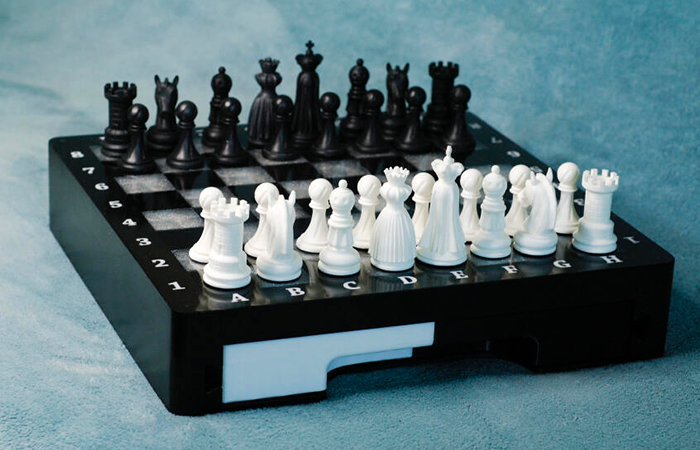
On the chessboard, there are three types of lines – files, ranks, and diagonals: 
- Vertical file. This is a row of squares running from bottom to top (or top to bottom). There are 8 files, each corresponding to a letter. Pawns usually move forward along the files. In chess, it is important to open files for the rooks, as they move vertically and horizontally. Files can be opened by exchanging pawns in the center of the board. If a file or line is left closed, the rooks will remain passive and have difficulty coordinating their actions. With an open file, a rook can freely move up and down the board and attack weak enemy pawns – backward and isolated ones. An open file is controlled not only by one rook, but also by the queen.
- Horizontal rank. This is a row of squares running from left to right. There are also 8 ranks, each corresponding to a number. The fields going from left to right are called ranks. You have the last rank, the 7th (also called the “7th heaven”), the 3rd, 4th, 5th, and 6th ranks. Similar to files, the rooks need access to the ranks, especially the 7th rank, where the opponent’s pawns will be an excellent target. The 7th rank (the 2nd rank for Black) is located deep in the opponent’s territory, and this is where the pawns begin their journey. If you manage to place both rooks on the 7th rank, the player gains a significant advantage. They will work together and capture any piece in their path.
- Diagonal. This is a row of squares of the same color, arranged diagonally. The fields going diagonally are called diagonals. There are a total of 26 diagonals. The shortest diagonal consists of two squares (next to the corners of the board). The longest diagonals are A1-H8 and A8-H1. Bishops usually move along the diagonals of the chessboard, up and down. If you manage to position two bishops on their own open diagonals, this can be a significant advantage over the opponent.
Each square has its own unique address, which consists of a letter and a number. Letters are used for vertical lines and numbers are used for horizontal lines.
Chess notation
The number of squares on a chessboard, the color and designation of the fields are certainly not accidental. The order of play and each player’s move in games, combinations, etudes can be written down using conventional designations. Such a system is called chess notation. On each chessboard there are eight letters (letters of the Latin alphabet – A, B, C, D, E, F, G, H, arranged in a row at the bottom) and eight numbers (from one to eight, arranged in a column on the side).
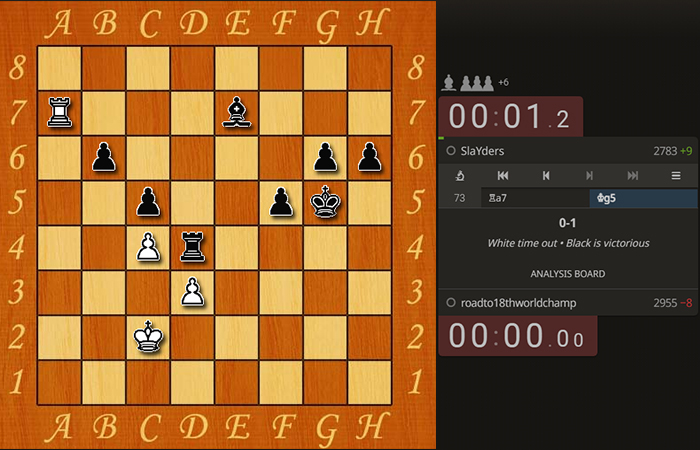
Each file corresponds to a letter (for example, file E), and each rank corresponds to a number (for example, the 5th rank). Each square on the chessboard has its own address – the intersection of a letter and a number.
This system of coordinates helps players to record their moves during the game. For example, if white made a pawn move, starting from the square “e2” and moving it to the square “e4”, the record of this move will look like “e2-e4”. Chess notation also makes it easier to remember the initial position of pieces at the start of the game and simplifies the analysis of the entire game.
Chess center
The squares located in the center of the board – the squares e4, d4, e5 and d5 – play a very important role in the game. They are called the main center, or small center. The extended center, or large center also includes squares around the main center: c3, d3, e3, f3, c4, f4, c5, f5, c6, d6, e6, f6.
Both players strive to quickly capture these central squares at the start of the game: usually the game begins with pawn moves to the main center (e4 or d4), and then the minor pieces are developed to the extended center (for example, the white knights are placed on the c3 and f3 squares, the bishop on c4). Control of the center is very important in the opening and middlegame: the player who more actively captures the center will have a spatial advantage, which is a strategic advantage.
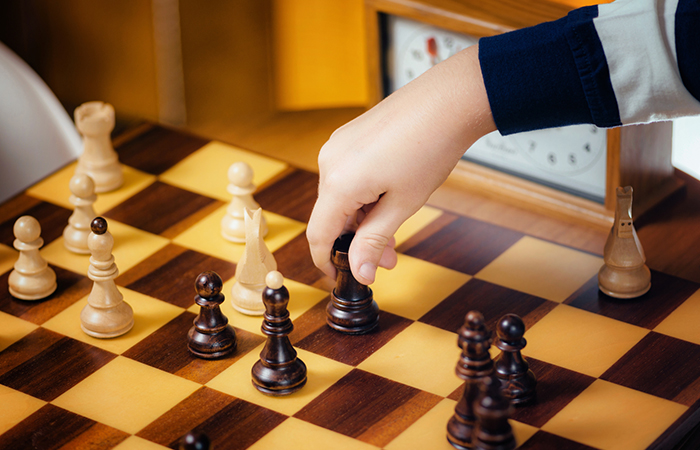
However, it’s not advisable to send your pieces to the edge lines without necessity, as on the edge of the board and in the corners they control fewer squares. The edge lines are even sometimes called the “swamp,” because the pieces there are limited in mobility. This doesn’t mean that pieces can’t be placed there at all: for example, the king can hide well in castling on the back rank. But, especially in the opening, it’s better to move central pawns rather than edge pawns, and to develop knights closer to the center – for example, for the white knight, f3 is a better square than h3.
Chess has been played for many centuries and in different countries, so the names, rules, and the arsenal of players can vary, and the 8×8 chessboard is not the only option. For example, in Mongolia, a variant of chess called Shatar was known, which used a 10×10 board. There have also been 12×12 boards, and the total number of squares on a chessboard was 144. But these variants are not used in international competitions, so it’s better to use the standard board.