The title of grandmaster is awe-inspiring for almost all novice chess players. It’s not surprising, because this is not just a title, it’s a recognition of the highest level of skill and talent, the achievement of which seems an unrealistic task. Or is it? Let’s try to understand: who is a grandmaster and what it takes to get this title.
Grandmaster in chess: the history of the title
It was the spring of 1914, and in honor of its tenth anniversary, the St. Petersburg Chess Club organized a tournament that was to go down in chess history as one of the most important. Only masters who had already won important international tournaments were invited. A brilliant tournament, during which Tsar Nicholas II personally appointed the five finalists grandmasters of chess at a banquet. This story of the emergence of grandmasters in the world of chess is very beautiful, but not entirely true.

The first recorded use of the term “grandmaster” in relation to a chess player was in mid-February 1838: the London newspaper Bella Life published an article about the outstanding English chess player William Lewis. Who is a grandmaster in chess? 
Grandmaster is the highest rank in the world of chess. Unlike the titles of world, European or national champion, the title of grandmaster is awarded on an honorary basis – if a player meets the qualification criteria.
As for the official awarding of the grandmaster title, the process is regulated by the World Chess Federation (FIDE). In 1950, as a first step, FIDE officially designated 27 players as “International Grandmasters” on an honorary basis. And as early as 1953, FIDE formulated rules and a system of titles.
How to become a grandmaster
It takes not only talent and passion for the game, but also serious dedication and hard work to write your name in chess history and become a grandmaster.

1. The earlier the better
Learning chess as a child has many advantages. Children who learn languages, music, and other challenging subjects at an early age have an easier time mastering them. As with languages and music, it takes years to comprehend the complexity of chess, and a child who starts chess between the ages of five and eight gets a head start on his or her competitors. At this age, a child’s brain is ready to absorb all the new lessons, tactics and ideas that are the foundation for becoming a strong player.
2. Constant training
Even the most talented players who have become grandmasters, like Magnus Carlsen, work hard. To strengthen all chess skills, you must practice daily, intensively studying all three phases of the game – opening, middlegame and endgame.
3. Participation in tournaments
A chess player should play thousands of games and study them in order to learn from defeats and become a stronger player as a result. Participation in tournaments provides an opportunity to test one’s skills, learn about the psychology of competition, practice time management and gain the experience necessary to become a stronger player.

If we take into account that the grandmaster is the highest step of the chess pedestal, then the path to this top in the FIDE system looks as follows:
- Candidate to Master (CM) – Elo 2200. The Elo rating is an assessment of the strength of the game, which the Association calculates for each participant in a tournament according to a formula proposed in its time by the Hungarian-American mathematician Arpad Elo.
- FIDE Master (FM) – Elo 2300.
- International Master (IM) – three norms and Elo 2400. What are “three norms in chess”: a player will need to score three times in three years in different tournaments (the criteria for the tournaments are clearly defined in FIDE).
- Grandmaster (GM) – three norms and an Elo of 2500.
Another way to get the title is to fulfill the Grandmaster norm at an event that is a qualifier for the World Championship match.
To become a grandmaster in one tournament, one must:
- take one of the first six places at the World Championship;
- from the first to the fourth place at the World Cup;
- become a gold, silver or bronze medalist at the European Championship.
There are also highly rated FIDE tournaments in which a good place or a win immediately makes you a grandmaster. For example, the world junior champion under 20 automatically becomes a grandmaster. But most often the title of Grandmaster is awarded to a player when he reaches the 2600+ mark in the Elo rating.
There is no need to challenge or confirm the title – it is awarded for life. It is worth noting that cases of deprivation of the title of grandmaster in history did occur. They concerned foul play.
Women’s Grandmaster
Women’s Grandmaster (abbreviated as WGM) is one of the official titles awarded to chess players by the International Chess Federation (FIDE). The title of Grandmaster among women was created in 1976. It is the highest title available exclusively to women.

The women’s titles are:
- Candidate Champion (WCM) – Elo 2000.
- FIDE Master (WFM) – Elo 2100.
- International Master (WIM) – three norms and Elo 2200..
- Grandmaster (WGM) – three norms and Elo 2300. .
It is worth noting that female chess players can receive any titles, not limited to titles among women.
The most famous grandmasters
Bobby Fischer

The American chess player became a grandmaster in 1958 and was one of the most outstanding players in the history of chess. His victory in a match against Boris Spassky in 1972, which received widespread media attention and was named the “Match of the Century”, made him a legend.
Garry Kasparov

Kasparov dominated world chess for many years. He earned the title of grandmaster in 1980 and became world champion in 1985. His uncompromising style of play and impressive achievements made him one of the most respected and famous grandmasters in history.
Mikhail Tal

Latvian chess player known for his unusual and creative style of play, he has been a grandmaster since 1957. He became world champion in 1960 and left his ineffable mark on the history of chess, for which he is often called “The Magician from Riga”.
Judit Polgar

Hungarian chess player Judit Polgar is one of the most brilliant and talented chess players in history. She was awarded the title of Grandmaster in 1991 and has long been one of the highest rated players in the world. Her style of play and technical skills make her one of the greatest chess players of all time.
Viswanathan Anand
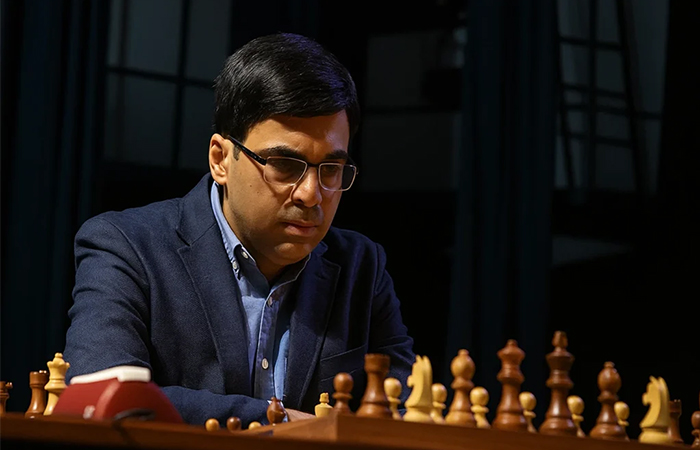
Indian Grandmaster Viswanathan Anand is a former world champion and one of the most respected figures in world chess. He earned the title of grandmaster in 1988 and continues to be one of the top players on the world stage.
Vladimir Kramnik

He became world champion in 2000 and today he is one of the most famous chess players of his generation. His technical skills and strategic approach to the game have made him one of the leaders of the world chess community.
Koneru Humpy

The grandmaster from India is considered to be one of the most talented and promising players. She received the title of Grandmaster in 2002 and already has an impressive list of achievements in world tournaments.
Nana Dzagnidze

Georgian chess player Nana Dzagnidze was awarded the title of Grandmaster in 2017 and has shown a high level of play in international tournaments.
Fabiano Caruana

American grandmaster Fabiano Caruana was awarded the title of grandmaster in 2007 and was a contender for the title of world champion. His dynamic style of play and ambitious goals make him an important figure in the modern chess world.
Magnus Carlsen

Norwegian grandmaster Magnus Carlsen, who became grandmaster in 2004, is considered one of the most talented players of our time. He became world champion in 2013 and holds his title at the moment. His dynamic and creative style of play sets him apart from other chess players. According to the International Chess Federation (FIDE) rating, Magnus Carlsen is in first place with 2830 Elo points.
How many grandmasters are there in the world now?
Once a title is conferred, it remains in effect for life. There are a total of 1341 active Grandmasters in the world as of August 2021. Of these, 157 are from Russia, 78 from Germany, 63 from Ukraine, 62 from the USA and 61 from India. The youngest chess player in the world to attain the title of Grandmaster was Abhimanyu Mishra. He received the title at the age of 12 years four months and 25 days. Before him, the record holder was Sergey Karjakin, he got the top title at the age of 12 years and seven months. These are not the only prodigies in chess.

As for women, the secret of how to become a grandmaster by 2020 has been revealed to 458 women chess players. This is a very small fraction of the millions of chess fans, but there are even fewer women chess players who have ever been awarded the title of grandmaster – only 37 as of January 2021. The first female grandmaster was Nona Gaprindashvili in 1978, and the record for the fastest time to obtain this title belongs to Hou Yifan – 14 years, six months and 16 days.
Although the number of grandmasters was still small in the 1950s, many players were already complaining about the “ mass popularity”. Therefore, some suggested that a new title – Super Grandmaster – be established for players with a rating of over 2700 Elo. But this has not happened yet, and grandmaster remains the most important title in chess.