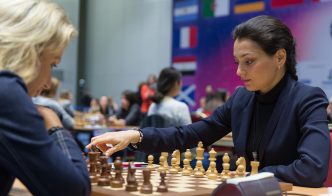
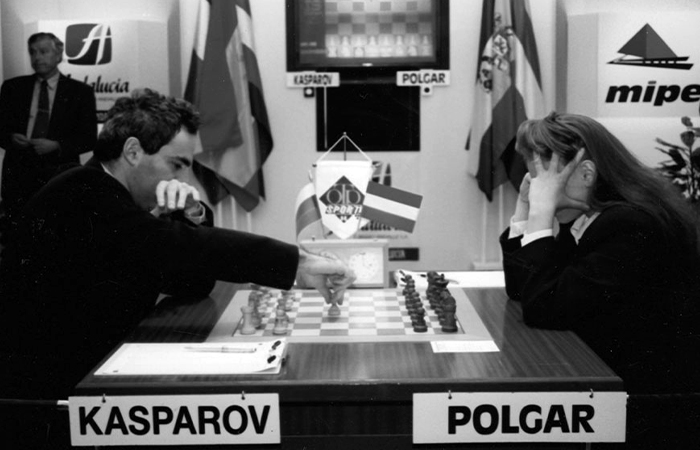
“There is real chess and there is women’s chess. Chess is not suitable for women. It’s a battle, you understand? A great battle. Women are weaker fighters.” This categorical statement was made in 1989 by Garry Kasparov, one of the greatest grandmasters in history. Yet in 2002, he lost to a woman: Judit Polgar, a Hungarian chess player and grandmaster. This episode became a symbol of the contradiction that has surrounded women’s chess for decades. On the one hand, there are prejudice and skepticism; on the other, achievements and results that cannot be ignored. Women’s chess championships have come a long way, from small-scale competitions in the early 20th century to fully fledged international championships with their own histories and traditions. In this article, Whychess has compiled a list of the most prestigious chess championships for women.
Why are there separate men’s and women’s chess championships?
There is no official division of chess tournaments into men’s and women’s events, and theoretically, anyone can apply to participate in an open championship. However, it is undeniable that men make up the majority of participants in the most prestigious chess tournaments. One of the main reasons is the historical imbalance: far more men than women played chess. Moreover, chess was long considered “not a woman’s pursuit,” and attempts to prove otherwise faced resistance. As a result, women had fewer opportunities to compete regularly at a high level, refine their skills, and earn rating points.
The problem could not be solved simply by introducing quotas for the number of female players, since ratings take years to develop, making it impossible to find a sufficient number of highly rated participants overnight. One solution was to establish a separate competition system in which female players could compete for international titles and develop their careers. The first official Women’s World Chess Championship was held in 1927 on the initiative of the International Chess Federation (FIDE). Its winner and the first women’s world chess champion was the legendary Vera Menchik. From that point onward, women’s competitions became an independent part of the international chess calendar.
In the context of chess history, women’s championships span a remarkably short period of time. Yet despite this, they have given rise to a fully developed ecosystem of competitions. Today, the list of international women’s chess championships includes eight major events:
- Women’s World Chess Championship
- Women’s Candidates Tournament
- Women’s Chess World Cup
- FIDE Women’s Grand Prix
- Women’s Chess Olympiad
- Women’s World Team Chess Championship
- European Individual Chess Championship for Women
- Women’s World Rapid and Blitz Chess Championships
These competitions differ not only in format and qualification criteria, but also in the role they play in the professional careers of female chess players. Below, we look at how each tournament works, who can participate, and what opportunities it offers to players.
Women’s World Chess Championship
Key facts about the tournament:
- First held: 1927
- Frequency: Every two years
- Format: A match between the reigning world champion and the challenger, usually consisting of up to 12 classical games
- Recent winners: Ju Wenjun, Tan Zhongyi, Hou Yifan
- Prize fund: €500,000 for the 2025 match
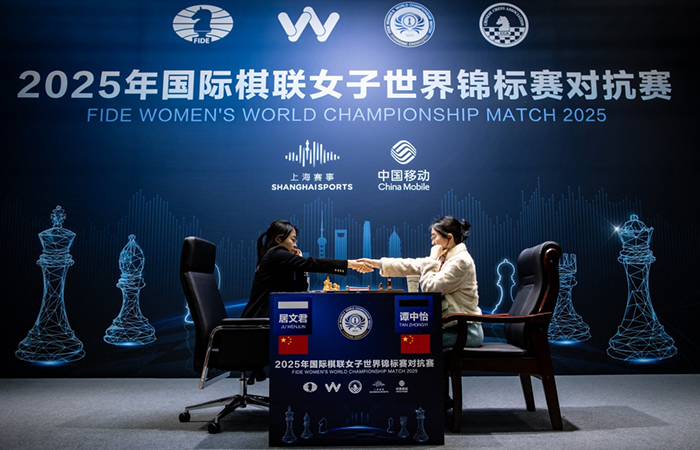
The championship began in 1927 with 12 participants from nine countries. Today, the Women’s World Chess Championship is the premier individual competition in women’s chess. In its early years, the title was decided through round-robin tournaments in which every participant played every other player. The format was subsequently revised to mirror that of the open World Championship. The final stage is a match consisting of 12 classical games between the reigning world champion and the winner of the Women’s Candidates Tournament. In 2025, Ju Wenjun successfully defended her title once again, defeating Tan Zhongyi.
Women’s Candidates Tournament
Key facts about the tournament:
- First held: 1939 (in its modern format, since 2022)
- Frequency: Every two years
- Format: An eight-player round-robin tournament
- Recent winners: Lei Tingjie (2022/2023), Tan Zhongyi (2024), Vaishali Rameshbabu (2026)
- Prize fund: €250,000 in 2026
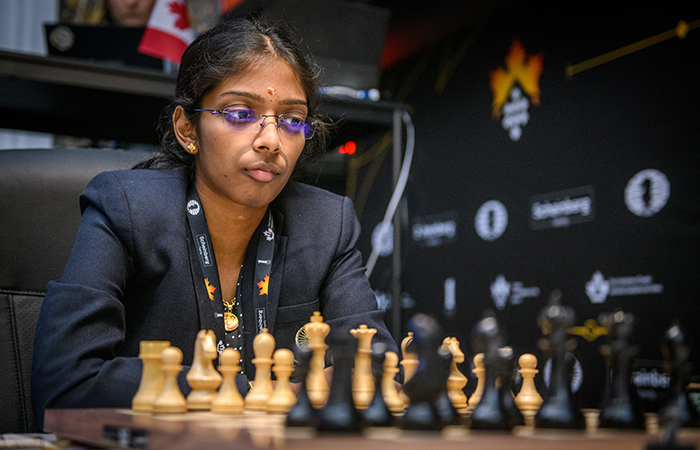
The Women’s Candidates Tournament is the final qualifying stage before the match for the title of women’s world champion. Eight of the world’s strongest female players, who qualify through the Women’s World Cup, the FIDE Women’s Grand Prix series, and the FIDE rating list, compete in a round-robin tournament. The winner earns the right to challenge the reigning world champion. The pressure is immense: an unnecessary draw or a mistake in a crucial game can cost a player her chance at the title. The first official Women’s Candidates Tournament was held in Moscow in the autumn of 1952. It was won by Elizaveta Bykova, who defeated the reigning champion, Lyudmila Rudenko, in 1953 to claim the world title.
Women’s Chess World Cup
Key facts about the tournament:
- First held: 2021, under FIDE auspices
- Frequency: Every two years
- Format: Knockout system, with elimination after losing a match
- Recent winners: Alexandra Kosteniuk (2021), Aleksandra Goryachkina (2023), Divya Deshmukh (2025)
- Prize fund: Approximately $700,000
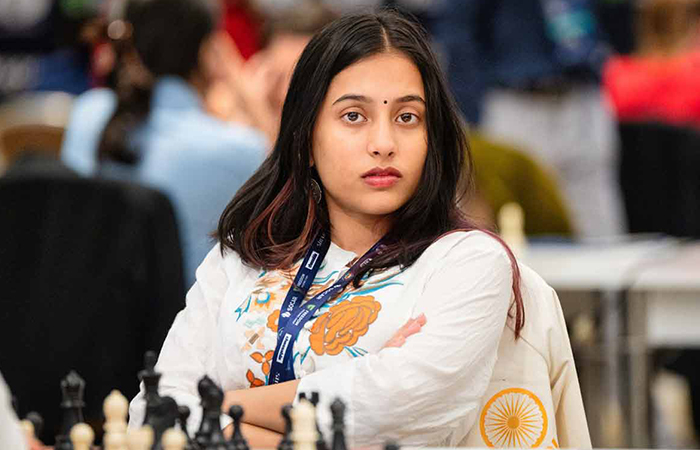
The FIDE Women’s World Cup was introduced considerably later than the World Championship but quickly became one of the most prestigious competitions in women’s chess. More than 100 players take part, progressing through several knockout rounds. In addition to the title itself, qualification for the Women’s Candidates Tournament is at stake. The top three finishers qualify: the winner, the runner-up, and the winner of the third-place playoff.
Interesting fact: In 2025, Indian chess player Divya Deshmukh won the Women’s Chess World Cup. At just 19 years old, she defeated one of the world’s strongest female players, Humpy Koneru, in the final.
FIDE Women’s Grand Prix
Key facts about the tournament:
- First held: 2009, under FIDE auspices
- Frequency: One series every two years
- Format: A series of round-robin tournaments (stages)
- Recent series winners: Aleksandra Goryachkina (2019–2021), Kateryna Lagno (2022–2023), Anna Muzychuk (2024–2025)
- Prize fund: From €600,000 for the entire series
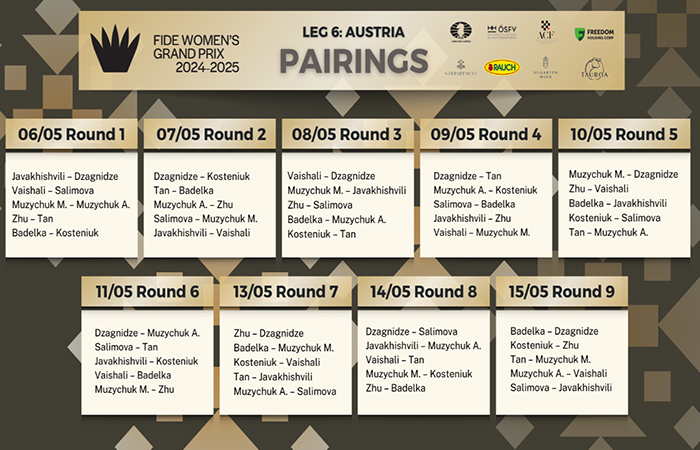
The FIDE Women’s Grand Prix is a series of competitions in which players earn points toward the overall standings. Six stages are held in different countries during the season, with each participant eligible to play in three of them. At each stage, ten players compete in a round-robin format, and their final positions determine the points they earn toward the overall standings. This format measures not only individual success but also consistency throughout the season. The two highest-ranked players in the series earn places in the Women’s Candidates Tournament.
Women’s Chess Olympiad
Key facts about the tournament:
- First held: 1957
- Frequency: Every two years
- Format: Team tournament using the Swiss system, with 11 rounds and four players per team match
- Recent winners: China (2026), India (2024), Ukraine (2022)
- Prize fund: No official cash prize fund
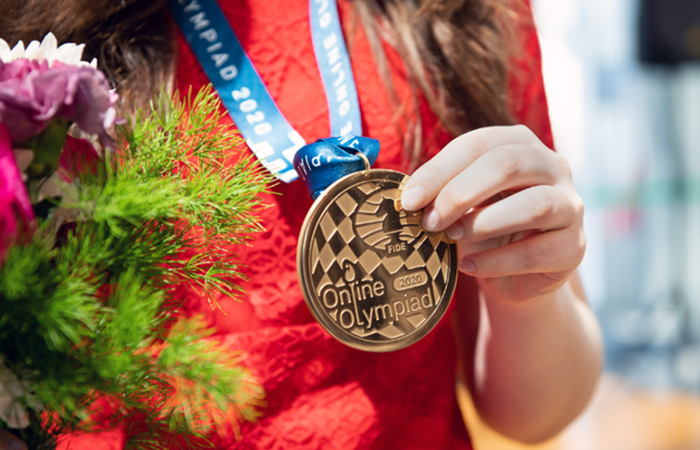
The Women’s Chess Olympiad is one of the largest team competitions in international chess. Unlike individual championships, it brings together national teams, and the final result depends on the performance of the entire squad. The competition usually follows the Swiss system, with teams earning points in matches played across several boards. In 2026, the Olympiad took place in Samarkand, Uzbekistan, and China won the women’s event, finishing ahead of Kazakhstan and India. The main trophy is the Vera Menchik Cup, named after the first women’s world champion. Gold, silver, and bronze medals are also awarded in the team competition and to individual players on each board.
Women’s World Team Chess Championship
Key facts about the tournament:
- First held: 2007, under FIDE auspices
- Frequency: Every two years
- Format: Group stage followed by a knockout playoff featuring 12 of the world’s strongest national teams
- Recent winners: Russia (2021), Georgia (2023), FIDE Team (2025)
- Prize fund: Determined by the organizers of each championship
The Women’s World Team Championship is a separate FIDE competition in which national teams compete for the title of the world’s strongest team. Unlike the Chess Olympiad, it features a limited number of teams selected according to established criteria. For example, 12 teams participated in the 2025 championship in Linares, Spain. During the group stage, they were divided into two groups, after which the strongest teams advanced to the semifinals and final. The FIDE Team won the title, Azerbaijan took silver, and China claimed bronze.
European Individual Chess Championship for Women
Key facts about the tournament:
- First held: 1986
- Frequency: Annually
- Format: Swiss-system or round-robin tournament, depending on the number of participants
- Recent winners: Ulviyya Fataliyeva (2024), Teodora Injac (2025), Anastasiia Hnatyshyn (2026)
- Prize fund: Approximately €60,000
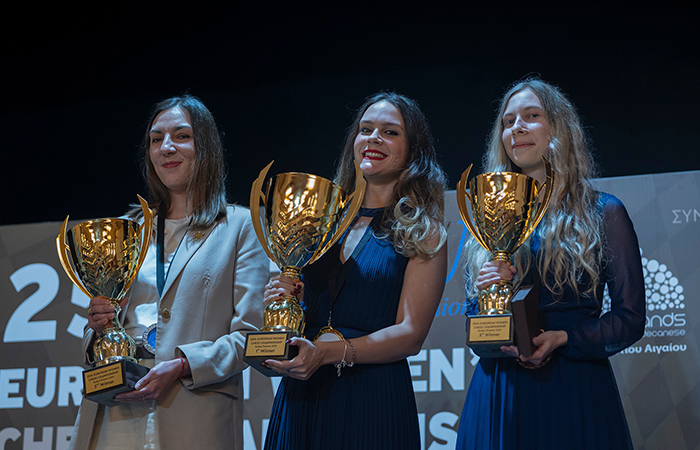
The European Individual Chess Championship for Women is the continent’s premier individual championship, organized under the auspices of the European Chess Union (ECU). Players representing national federations affiliated with the ECU are eligible to participate. The tournament follows the Swiss system, with players competing over 11 rounds and pairings determined according to their scores. In addition to the European title, the championship offers an important career opportunity: the top finishers qualify for the FIDE Women’s World Cup. In 2026, Ukrainian chess player Anastasiia Hnatyshyn won the event in Batumi, Georgia. She was 15 years old at the time and scored nine points out of a possible 11.
Women’s World Rapid and Blitz Chess Championships
Key facts about the tournaments:
- First held: The Women’s World Rapid Championship was first held in 2012; the unified format alongside the open championships dates back to 2016
- Frequency: Annually, traditionally in late December
- Format: Rapid: Swiss system (11 rounds); blitz: Swiss system (17 rounds)
- Recent winners (Rapid / Blitz): Anastasia Bodnaruk / Valentina Gunina (2023), Ju Wenjun / Bibisara Assaubayeva (2024/2025)
- Prize fund: €150,000 for each tournament in 2025, totaling €300,000 for the women’s events
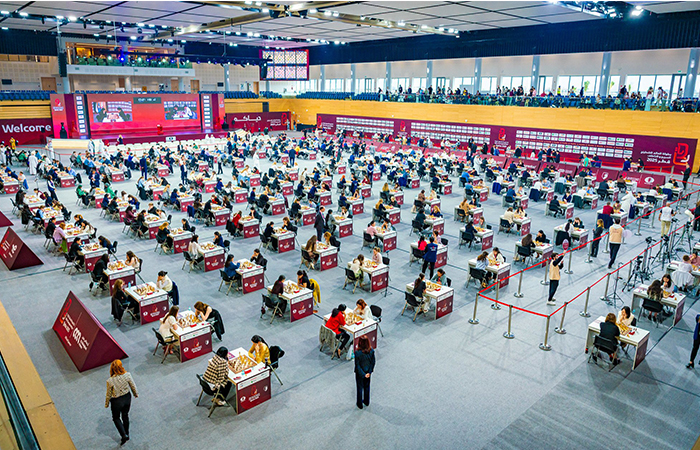
The World Rapid and Blitz Championships are the year’s most spectacular and fast-paced chess events, traditionally held in the days leading up to New Year’s Eve. Players compete for two sets of titles: in rapid chess (15 minutes plus a 10-second increment per move) and blitz chess (3 minutes plus a 2-second increment per move). The extreme time controls and large number of games played over a short period demand lightning-fast reactions, nerves of steel, and exceptional concentration. These championships clearly demonstrate the skills that chess develops.
In 1927, 12 players from nine countries gathered around the chessboard, and this was considered a major event in chess history. Today, according to FIDE’s Gender Equality in Chess Index (GECI 2026), the number of active female chess players worldwide has exceeded 238,700, and the index covers 119 federations across all continents. While broader social progress has undoubtedly played a significant role in this development, women’s chess championships have also made an important contribution. They have established a clear system of evaluation and ratings. From Vera Menchik’s first championship to the victories of Ju Wenjun and Divya Deshmukh, the world’s best female chess players have repeatedly proven through their achievements that there is no room for prejudice at the chessboard.